Part I: Self-image in Filipino culture
Hawaii is one of the most unique states in America: an island in the Pacific Ocean, far smaller than any other state, but home to dense amounts of cultures, most notably Asian ones. This is partly due to the large influx of Asian immigrants moving to Hawaii to work on plantations in the early 1900s.
The two largest Asian demographic groups in Hawaii—Japanese and Filipino—have been consistently close in size since the 2000s. However, I’ve felt that talk and appreciation of Asian culture in Hawaii tends to overlook Filipino culture. That is in no means to say that the amount of appreciation for other Asian demographics, Japanese, Chinese, or Korean, is undeserved or unnecessary.
The issue is much more nuanced and complex, going beyond Hawaii. However, it’s an observation that lies heavily on my heart as a Filipino growing up in Hawaii my entire life. Despite Filipinos being the largest Asian demographic in the state, I’ve felt there’s always been a lack of pride and appreciation for it. I hesitate to say this because I want to make it blatantly clear that I am not arguing against other Asian cultures being valued and cherished.
An excerpt from a 2023 Honolulu Civil Beats article by Jonathan Okamura—a professor in the Department of Ethnic Studies at the University of Hawai’i at Manoa—reads, “Filipinos now comprise the second-largest group after whites in the islands. But a relative lack of knowledge and recognition of their history, accomplishments and contributions leads them to find ways to emphasize those things and gain acknowledgment for their contemporary roles in society.”
Growing up, I can think of at maximum one kid in my elementary school grade who also was mainly Filipino. At Kalani, I know of at least two, besides myself. Now obviously that’s absolutely not all of the Filipino kids at Kalani, just two who have told me for sure. (I mean I wouldn’t want to assume others by looks of course).
This is also due to the fact that despite living in Kalihi my entire life, my mom enrolled me in schools around Kahala and Kaimuki because they were closer to her work. However, as I followed my friends to what eventually led me to Kalani, I started realizing just how different my life was compared to that of my friends.
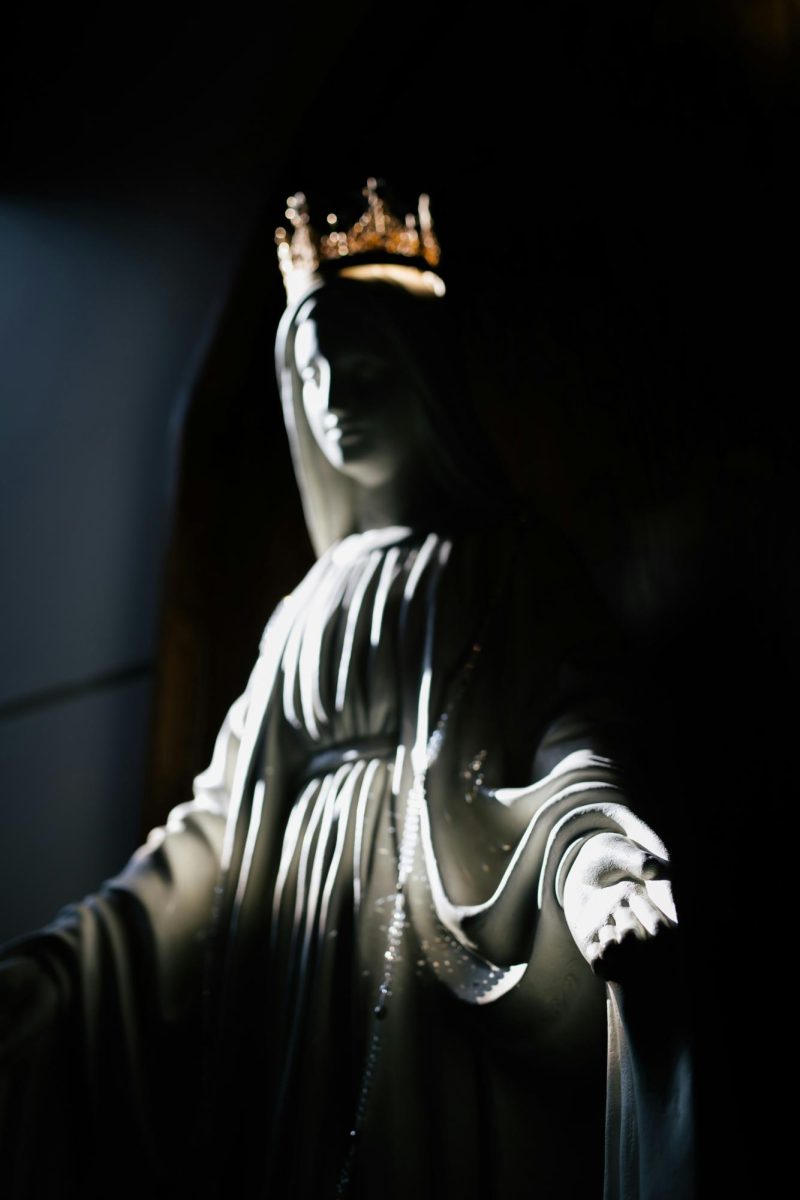
I think more than anything else, the biggest difference is in religion. I am not religious myself, but my mother’s side of the family—specifically my grandmother—has always been Catholic. I was ludicrously blind to the fact that a giant picture of the Virgin Mary watching as you ascend my staircase might be a ‘tad’ intimidating. Neither is like 20 pictures and statues of Jesus and Mary on a dresser right before you enter the bathroom.
It’s a whole other nuanced issue, but for many, being Filipino and growing up Catholic go hand in hand. I was lucky enough to have a mom who only made me go to church out of respect for my grandmother, and an atheist father who just wanted it to be my choice. I was baptised and went to church for years until the pandemic.
Despite being definitively atheist now, to me religion was one of my strongest ties to my Filipino ethnicity. And I still hold a lot of respect for Catholicism because of it.
As I’ve grown, I’ve become increasingly interested in trying to not just connect with Filipino culture, but simply identify it.
In the interest of exploring Filipino identity, specifically in Hawaii, I’ve decided to explore multiple demographics of Filipino communities.
Part II: Anakbayan Hawaii
Anakbayan USA is a national organization of Filipino youth and students who fight and advocate for the Philippines’ freedom and democracy. Despite the Philippines technically being a democratic country, with a constitution, president, Congress, and an independent judiciary. It has long been criticized and accused as being corrupt, flawed, and elite-led under spoils systems (Freedom House).
“Anakbayan holds the belief that Philippine society today is not truly free nor democratic,” Anakbayan-USA’s mission statement states. “It is under the control of U.S imperialism, along with local landlords, big capitalists, and corrupt government officials. The National Democratic Struggle seeks to realize true national liberation for the country and the realization of the democratic rights of the people.”
According to an article by the Hawaii Filipino Chronicle, Anakbayan Hawaii was founded around March 2020. It originally was established prior to that, but dwindled in an unspecified timeframe due to a general lack of interest or involvement, only to resurface again by a group of students at the University of Hawaii at Manoa.
Ken (pseudonym used to protect their identity as an immigrant) was a student at the University of Hawaii at Manoa at the time and was interested in getting involved and helping with the political situations in the Philippines. Ken grew up in the southern Tagalog region of the Philippines and moved to Hawaii when they were 12.
“It was a pretty rough transition because–you know–being plucked away from home when you’re at the peak of your beginning adolescent years,” Ken recounts. “I had a very strong connection to my family and friends back home. And so adjusting was really difficult, but I think what really helped was seeing how many Filipinos were also here. Being able to keep in touch with my culture and the language that I spoke.”
Ken describes the move during their adolescence as a “tough” change, but felt comforted by the Hawaii communities that also spoke Tagalog. As an adult, they express how Anakbayan has allowed them to continue feeling linked to their culture in a new, more politically open way.
“For so many of us, it’s not stuff that we’re raised on, you know?” Ken states. “Growing up in the Philippines, I did not learn any of this stuff. The education back home was very much Americanized and very watered down to make colonizers seem like heroes.”
Ken discusses how in the Philippines, the U.S. is depicted as “heroes.” And not until moving to Hawaii and taking a Filipino pop culture class did they learn about the Philippine-American War.
“And that—like—opened my eyes to the reality of the situation. It’s kind of what politicized me.” Ken says.
Other Anakbayan members recount their own personal stories, but ultimately all share similar themes of connection to their culture through Anakbayan’s political movement.
Imari Olipani is from the Northern regions of the Philippines and moved to Hawaii with her family at three years old. They moved to Kalihi into a house shared with another Filipino family. Her three family members and she lived in a single bedroom of the house.
Olipani comments on how it was truly the community that “held them down” while they tried to get back on their feet.
Olipani’s grandmother gave birth to nine kids and immigrated to the Big Island, working on the macadamia nut farms. Her grandmother raised and petitioned money to bring each of her kids to the Big Island one by one.
After her dad and some of his siblings decided to move to Oahu, Olipani recounts growing up in Kalihi, going to Goodwill, shopping second-hand, and overall trying to save as much money as they could.
“So that’s where I was coming from when I said I saw a lot of what we’re experiencing, in the struggles in Hawaii,” Olipani illustrates. “My grandma, she was a farmer back in the Philippines before she moved. So what she was experiencing in the Philippines kind of forced her to migrate to Hawaii and us here in Hawaii had our own experiences of struggle as well, which is connected.”
Tiffany Ganir, another member of Anakbayan, shares her familiar story. Even down to relating to Olipani’s father having eight siblings, as Ganir’s dad was one of 11 children. Her father was from Ilocos Norte and migrated to the Big Island before slowly bringing his siblings to Oahu.
Her dad moved to Wahiawa and worked on the plantations there. She also states that while it’s common to see Kalihi and Waipahu as the main areas with a Filipino population. Wahiawa also has a lot of Filipinos, along with many other areas that just don’t get talked about as often.
Ganir’s parents worked different shifts to juggle each having two jobs and taking care of Ganir herself.
“I think my parents, they tried to think about how can I blend in as much as possible, right?” Ganir recounts. “And a part of that is embracing local culture here. Which is so beautiful because we have so many different cultures. But part of that, you know, comes at the expense of assimilation.”
So Ganir, like many others—and not just Filipinos either—was limited in ways to connect to her culture growing up. Something shared not just among Filipinos but constantly around the world, embedding a lot of people back to their heritage, if nothing else does.
“I think I just remember a lot of our Filipino food,” Ganir notes. “Anchoring a lot of my interests and actually planting the seeds and getting to know what Filipino culture is.”
Ganir reminisces on complex palettes of sour, salty, and sometimes sweet foods.
“I don’t think I actually even knew what they were called,” Ganir adds on.
When Ganir attended school in Oregon—which lacked many other Filipino people—she truly realized how much her roots mattered to her. It was in these moments when she pondered how to be “in touch” with the culture that she turned to food, putting names to the dishes that marked her childhood.
Olipani’s family highlights this as well.
“My entire family is just cooks: my mom, my grandpa,” Olipani continues. “And so that was another way that I was able to maintain my connection with the Philippines, which was learning all the Filipino food.”
Ken used not just food as their anchor, but TV shows and the Filipino language overall, as their way of “reclaiming their culture” when moving here.
Olipani attended her mother’s ESL class even before starting preschool or kindergarten, in an attempt to “unlearn” Tagalog and start speaking English. However, she still used TV shows, movies, and teleseryes—similar to Ken—as her connection, even if she doesn’t really speak that much Tagalog anymore.
The three continue to recount similar, small but distinct cultural connections. Food, language, and values such as family, and how that leads to common patterns seen in Filipino communities, such as large parties and holiday events.
Ken portrays memories of going to church every night for a week and ending with a big party on New Year’s Eve that goes all night. Days of gifts, fireworks, eating, and yes– even karaoke.
And of course, even though it’s a complex, intertwining relationship, they recite how religion played a big role in their Filipino cultural upbringing as well. Many of these large parties are due to the religious backgrounds behind them. Including some parties for things like baptisms and communion.
Food, language, family, and even religion all anchor them back to their heritage. Ganir, Ken, and Olipani all reiterate at the end of their stories how it’s these things that make them care. “Politicizing” them and giving them ultimately a reason to fight for what they do.
All of this rich culture shared is fuel to the flame that is Anakbayan’s purpose and existence. Ganir cites the hardships of Filipinos both here and in the Philippines.
Ganir describes three root problems that cause Filipinos to migrate out of the Philippines in the first place. Firstly, U.S. imperialism. America makes as much profit as it can in a capitalist society, and when it reaches its limit, it has to expand overseas. So they go to other territories to make more profit, such as the Philippines, where they exploit cheap labor. This is facilitated in what Ganir and Anakbayan as a whole say is the bureaucrat capitalists, the second root problem.
Ganir continues to remark how corrupt government officials facilitate the process of selling off the cheap labor of the Filipino people, Filipino land, and the country to foreign corporations, mainly imperialist countries like America. Where they then take and sell off Filipino resources, such as trees and rich minerals.
This leads into the third root, feudalism, at least in an economic sense. Politicians sell Filipino land and its rich materials to other countries for cheap and refined materials get sold back for much higher prices. Ganir explains that 60 to 65 percent of Filipinos live in the countryside. In other words, if there are no factories or industrial businesses, the only jobs that exist are farming.
This delves even further when Ganir explains that the farmers aren’t even selling their own farmed crops. They work under landlords and the crops’ profit goes to equipment and seeds in exchange for housing. Creating this economic relationship that reflects a feudal system more than anything truly capitalistic.
“We say the solution is national democracy with a socialist perspective,” Ganir declares. “So if we understand that these three root problems: U.S. imperialism, bureaucrat capitalism, and feudalism are plaguing the Filipino people. And that they actually force them, over six thousand of them, to go abroad every day; we need to address those three problems so that people actually have a reason to stay. Because a lot of the reason why our families have moved was for more financial stability, right?”
Ken notes the issue of America as they describe it, a lack of government support for education, healthcare, and the general livelihood of its citizens. They explain how these issues are directly connected to the struggles of Filipinos because of the way that Filipinos are forced to migrate here for jobs.
However, despite all of that, Ken follows up with grim intensity.
“But it’s even worse back home,” Ken states. “So there’s a direct correlation between it, and that’s something that we try to raise up in our organization.”
Part III: My Family’s Story
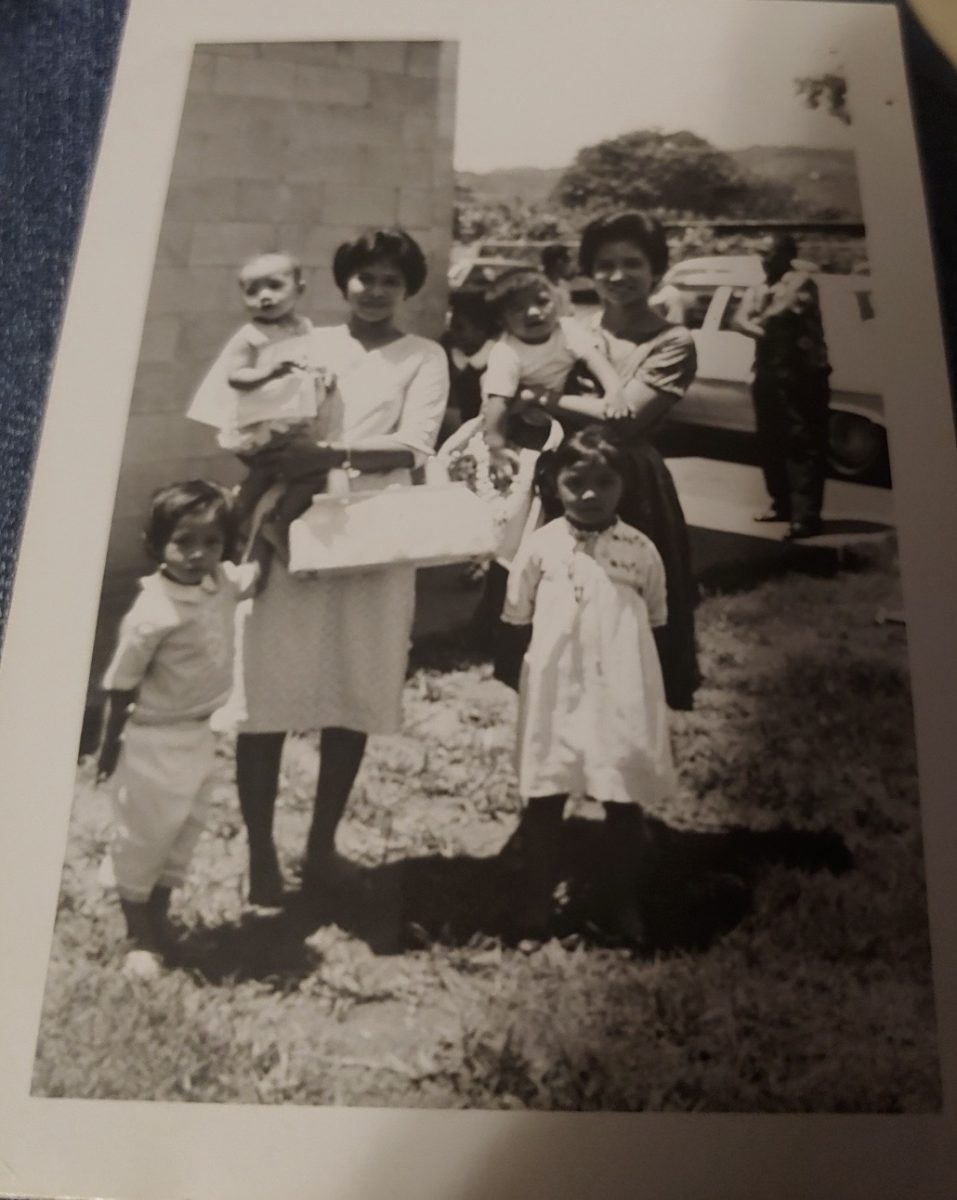
The next Filipino demographic I wanted to interview was much more personal. I have known bits and pieces of how my family came to Hawaii; however, I wanted to learn more.
Josie Togle is my auntie on my mother’s side of the family, and the oldest of my mom’s sisters. She came with my grandmother to Hawaii very early in her life. As such, she knows a lot about the family’s history and my grandparents.
She recalled in detail each stage our family went through while moving. My grandfather, Vincente Togle, started as a plantation worker. He moved to the U.S. for free, and in exchange, he worked on pineapple plantations.
The reason I wanted to interview my auntie Josie is that I remember one time when she was visiting (she lives in California now) she told me this exact story briefly: “The consulate in the Philippines asked, ‘Why do you want to move to the United States? They have a depression there?’” Josie details, “And grandpa said, ‘Anything’s better than living here.’”
Josie explains that her father had big “ambitions” and “aspirations,” and the Philippines, especially at the time, was incredibly rural, so he wanted to make a better life where he believed he could make more money.
Eventually, he was able to bring my grandmother and Josie to Hawaii as well and it was there that my Auntie Lorna and, of course, my mother Annibelle Togle-Wilson were born. They moved around a lot when they were young, sharing houses with distant relatives or just close friends, with sometimes just one room to themselves.
Before my grandmother started working, my grandfather worked three jobs.
“He was running on pure fumes because he just, he never slept or hardly slept because he was working all the time,” Josie explains.
My grandparents then decided it would be best for my grandfather to take a job working in the Marshall Islands. It provided better money, but obviously meant he’d be away for long periods of time.
Josie recounted almost a dozen family members they had lived with, even after all this time.
“That was memorable,” Josie states. “The memorable things were just family getting together. Whenever grandma had a party, she would invite the whole, all the relatives. And grandma was always making food, cooking her, baking her babinka, making her pancit and ham.”
My mother jokingly adds how grandma would invite the “whole world.”
“It’s not a Filipino practice, but Catholic; Catholicism was pretty ingrained in our lives because Grandma was just pretty religious,” Josie notes. “There are other religions that dominate there, too, but it’s kind of intertwined in the Filipino culture.”
So Josie recounts how a decent part of her Filipino culture stays with her through religion.
“I pray because it makes me feel more at peace,” Josie states. “And it helps me appreciate the great times.”
Josie recites how “neat” it was to have the culture blend that was Hawaii., how it all led the family to follow what she called “Hawaiian American culture.”
Josie tells a humorous story about how she would call our family– due to its wide range of cultures and immigrant generations— a “joint family.” However, one time when she said it to my grandmother, she had heard “junk family” instead and scolded Josie relentlessly for it.
“She just thought I was criticizing the family,” Josie remarks.
Josie praises our grandparents and their examples of Filipino values. And they were great examples for not just her but my mother and my other auntie.
“The value of hard work that has impacted me just because I had that,” Josie emphasizes. “I would hear from relatives or friends of grandma and grandpa telling us how good our parents were. So that makes me feel good and makes me want to be, you know, kind of emulate them because they were great examples of good people.”
Josie lists many things my grandparents did with an overall sense of pride about them. Even stories I’ve known from before, and the time I did get to know my grandmother, the lingering feeling about her and my grandfather was always pride.
Through writing this article, I’ve realized that the Filipino value of family is displayed in many ways. Through a passion to make our homeland better for our families. Through a tight-knit community of close to distant relatives whose names you still keep close to heart. Through my grandma, who retired very late in her life and even after would get up to water plants and do household chores for the family, despite people telling her to rest for her health. Through potluck dinners and karaoke nights of rupturing laughter. Through an overwhelming pride for the culture and everything it has taught you.
My hesitance to write this article—despite how passionately I wanted to—came from the shame of seeming overly prideful. However, I realized that the pride I felt was less for me and more for my family. I love my family, and before I move away for college, I wanted to write how proud I am to be a part of them.
“There were times when I felt like ‘oh I wish I was more Americanized.’” Josie describes. “But grandma and the family would bring us back because religion and the cultures and superstitions and beliefs basically ruled in grandma’s house because she was pretty strong-willed.”