Artificial Intelligence is a topic the media is all too familiar with by now; it has infected every facet of our online lives and some of our offline lives as well. Google forces an “AI Overview” to the top of searches with no setting or way to turn it off except for a third-party web extension or an obscure keyword added to the end of every search you make (it’s “-ai” by the way). Almost every company’s website has an “AI assistant,” and almost every social media platform has “AI chatbots” for some reason. Even if you are not online at all, you can happen upon an AI assistant taking your order at a drive-through.
However, what’s possibly the most egregious surge in the use of Artificial Intelligence is its use by students. According to research done in February by the College Board, approximately 74 percent of faculty report that students are using AI to write essays or papers. This is a decrease since research done in October 2024, which reported that 84 percent of students used generative AI for their schoolwork.
Protests against AI have been endlessly asserting its detrimental environmental and intellectual effects. In June 2025, the National Education Association reported on the disturbing disparities in AI’s energy usage. Stating that a single AI text query consumes energy at four or five times the magnitude of a typical search engine request. And generating a single image using AI consumes as much energy as charging a phone to full power. In Education Week, reports done in October of 2025 show 70 percent of teachers worry that AI weakens critical thinking and research skills.
These points can and should be repeated until the end of time; however, despite it all, Artificial Intelligence is here to stay. That is a fact that cannot be disputed, but in all the protests against AI that rely on logos, it can be easy to forget another reason why writing for ourselves is important. One that is much more grounded in humanity and its passions; writing is an art form, one that many can learn to love, or at least appreciate, rather than just a chore in school.
Jack Lehane is a musician and lyricist with a general love of writing. He mostly writes poetry that typically gets used as lyrics for his songs. Lehane remarks on his disdain for Artificial Intelligence as a detrimental “handicap” that takes away from writers the opportunity for purposeful word choice, content, and intent.
“I think that ‘unskilled’ writers, when using AI to completely or partially write anything (be it an essay, email or—God forbid—poetry) deny themselves the opportunity to develop their skills while simultaneously outputting what really is just poor quality, soulless sludge at its best,” Lehane contends.
Violet Moura (9) has been writing for fun her entire life. In sixth grade, she won an honorable mention from Scholastic for her short story. She mentions her appreciation for how it doesn’t give you a “concrete image” and the overall beauty of symbolism and interpretation.
“When I read books, I get to think of what things would look like,” Moura explains. “I like how it makes you visualize with your head instead of just looking at it and just getting the information. I don’t like generative AI, it’s kind of gross to me, honestly.”
Moura reiterates how much joy she gets from writing’s subjectiveness and room for analysis. How even when writing something nonfiction, such as an essay or news-writing, it’s still ultimately an art form to choose specific words that convey a story.
“I like to do writing because– it’s very fluid,” Moura describes. “For art—like drawing art—I think it’s fluid in a way. But it’s still pretty stagnant. I find that in writing, you can do more different things because you don’t have a canvas, you have a sheet of paper. And you can fit a lot more on a sheet of paper.”
Lehane finds expression in writing in similarly symbolic ways. He narrates trying to take many emotions and experiences and veil them in symbolized ambiguity.
“This is a skill I admit that I am still working on,” Lehane remarks. “For a long time, I tried to hide what I was thinking about through obfuscation. What I mean is that I was being intentionally vague to avoid the uniquely embarrassing vulnerability that is writing about the things in my life in a direct way. To some extent, my favorite writers (mostly songwriters) are the ones who can speak about their lives bluntly while still speaking with a high degree of nuance.”
Moura recounts an online anecdote about someone who read “The Hobbit” and always imagined the hobbits as mouse-like, because they were described as having fuzzy ears and big feet. And Moura proclaims that example as representing just how uniquely interpretative only writing can be.
“I think that writing as art is very underappreciated,” Lehane answers. “Writing in general is incredibly important, especially right now. Not only artistic writing like fiction or poetry, but also journalism and academic writing alike.”
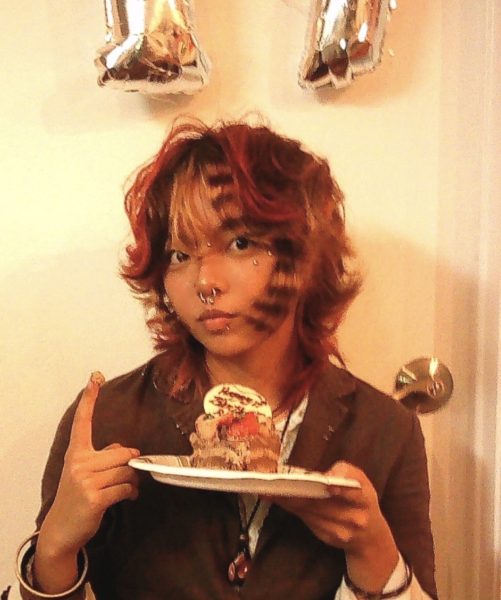
Calvan (pseudonym used) is a senior in their high school and also describes themself as having been writing ever since they could hold a pencil. They defined themselves as having an “extremely vivid imagination,” which has led them to particularly enjoy writing fiction.
“Writing is a form of art,” Calvan states. “What makes art [and] writing special is that it comes from people, human experience. No one simply ‘generates’ a piece of writing that is completely separate from their experiences. Whenever someone creates, whether that is a painting, a makeup look, or a writing piece– everything that that person has undergone and seen, it shapes them, it shapes how they perceive the world, and it shapes how they interact with it– their art is inseparable from their experiences and personal meaning. That’s what makes art and writing—when made by people—special.”